Most of the technique names sold in hair transplant marketing describe one step, one tool or one material — not a separate operation
A hair transplant is not one procedure with many rival versions. It is a sequence of three separable steps, and almost every branded name you will see online refers to a tool used in one of those steps. Understanding the sequence is the fastest way to read a clinic's offer accurately, because it lets you see which part of the operation a name is actually describing — and which parts it says nothing about.
The three steps every transplant shares
Whatever it is called, the operation consists of:
- Extraction — removing follicular units from the donor area, either as a strip of skin (FUT) or unit by unit with a small circular punch (FUE).
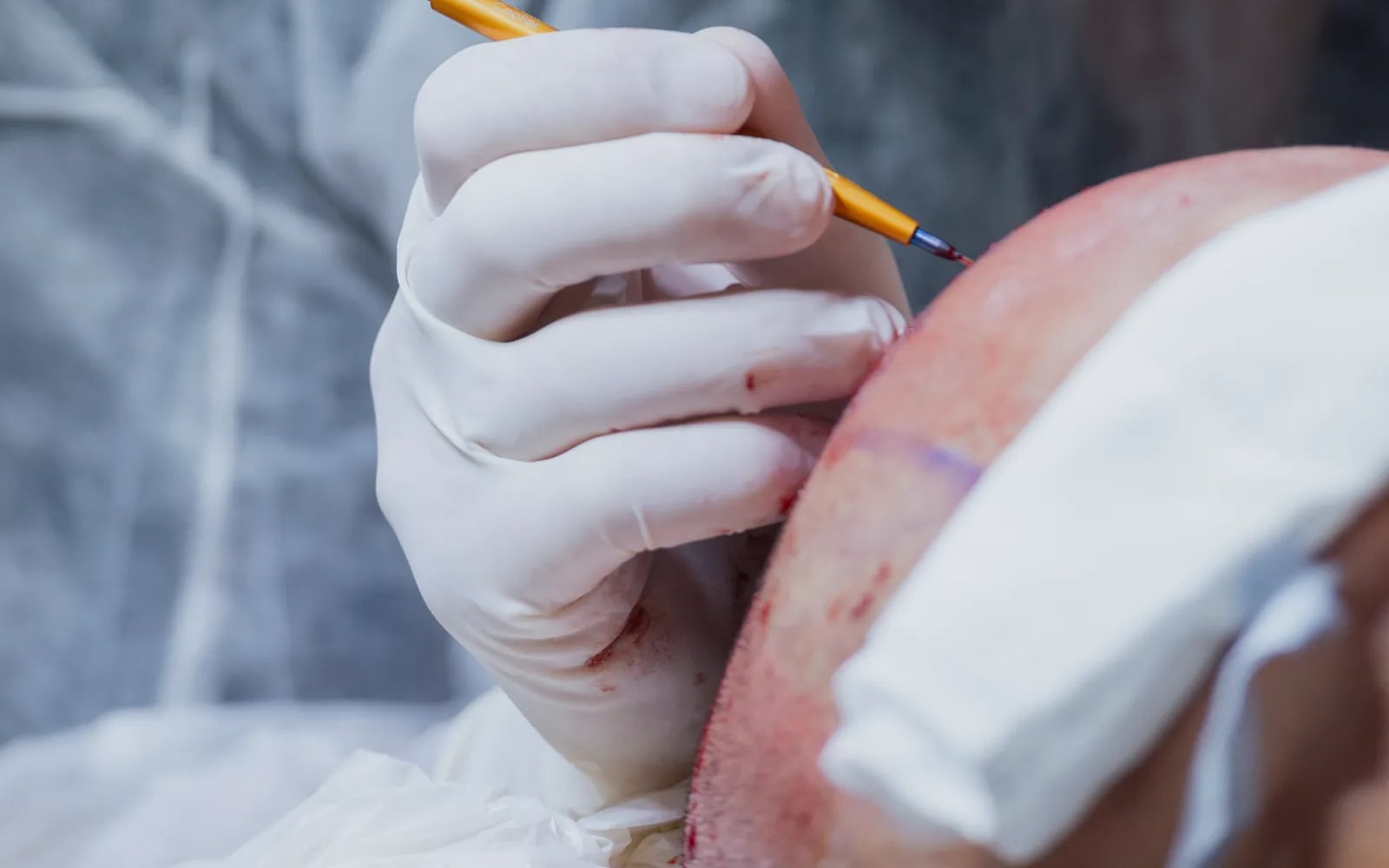
- Recipient-site incision — opening the sites in the balding area that will receive the grafts, at a chosen angle, depth and density.
- Implantation — placing each graft into its site.
A follicular unit contains one to four hairs. In FUE, punch diameters are typically 0.8 to 1.0 mm, and the professional guidance sets a target transection rate — grafts damaged during removal — of under ten per cent. Those two numbers tell you more about extraction quality than any brand name does.
What "sapphire" refers to
Sapphire is a blade material. Blades made from synthetic sapphire crystal are used to make the recipient-site incisions instead of steel. That is the whole of the claim.
The International Society of Hair Restoration Surgery does not recognise "Sapphire FUE" — or "Ice FUE", "Gold FUE", "micro FUE", "nano FUE", "FUE2", or "third-" and "fourth-generation FUE" — as distinct procedures. The peer-reviewed literature that does compare incision instruments compares blade geometry and cutting mechanism: how wide the slit is, how deep it goes, how cleanly it opens tissue. No trial has shown that the material a blade is cut from improves graft survival.
That does not make sapphire blades bad. It makes the name uninformative. We list sapphire FUE as a service because that is the term patients search for, and we would rather explain it than pretend it means something it does not.
Incision geometry itself does matter, and mechanically so. A 5 mm slit penetrates 5 mm at 90 degrees, 3.5 mm at 45 degrees and only 1.3 mm at 15 degrees. Average scalp thickness is around 4.3 mm. The angle at which sites are opened therefore determines whether grafts sit at the right depth and whether hair emerges in a direction that looks natural.
What DHI refers to
DHI stands for direct hair implantation, and it describes the implantation step. Instead of making the site first and placing the graft with forceps, the surgeon uses a sharp implanter pen — a Choi-type instrument — which cuts the site and delivers the graft in one movement.
The ISHRS position is explicit: DHI "is not a hair transplant method and should not be marketed as such". No randomised trial has shown implanter pens produce better graft survival than forceps. Implanter pens have genuine practical advantages in some hands and some situations, and experienced teams have real preferences. What they are not is a different operation.
Two other claims deserve naming directly. "Scarless FUE" is false: FUE always leaves small round scars in the donor area, and the question is whether they are small and well distributed enough to be invisible under your hair length. "Performed entirely by a robot" is also false — devices assist, they do not operate alone.
What genuinely drives the result
The variables with real evidence behind them are unglamorous, and none of them is a brand.
- Out-of-body time. Graft survival falls as grafts wait outside the body — roughly 95 per cent at two hours, 90 per cent at four, 86 per cent at six, 79 per cent at 24 and 54 per cent at 48. Treat that as a trend, not a precise curve.
- Storage. Grafts are held in solution at 4 to 10 °C. Desiccation can kill a graft in as little as three minutes of dry exposure.
- Packing density. Survival appears to fall as sites are packed more tightly — around 97 per cent at 10 follicular units per cm², 92 per cent at 20 and 72 per cent at 30 — though this finding is contested and strongly operator-dependent.
Even the FUT-versus-FUE comparison is unsettled. One study reported survival of 53.9 per cent for one and 85.2 per cent for the other; another found them equivalent. Anyone quoting you a single settled survival percentage for either is quoting something the evidence does not support.
How to read a clinic's technique page
Ask what a name refers to. If the answer is a material or an instrument, ask what the clinic does about the things that are known to matter: how long grafts stay out of the body, how they are stored, what density is planned and why, who makes the incisions. Ask who performs each step and what their licence is. Those questions are harder to answer with a slogan.
How the technique is described here is set out on the hair transplant page, alongside the rest of our treatments, with what a session includes under packages and prices.
None of this substitutes for an assessment of your own scalp. Donor density, the pattern and stage of your loss, your age and your expectations all change what is sensible and what is possible. Send us photographs of your hairline, crown and donor area through our contact page and we will give you an honest assessment, free of charge, including if the answer is that surgery is not the right step yet.