
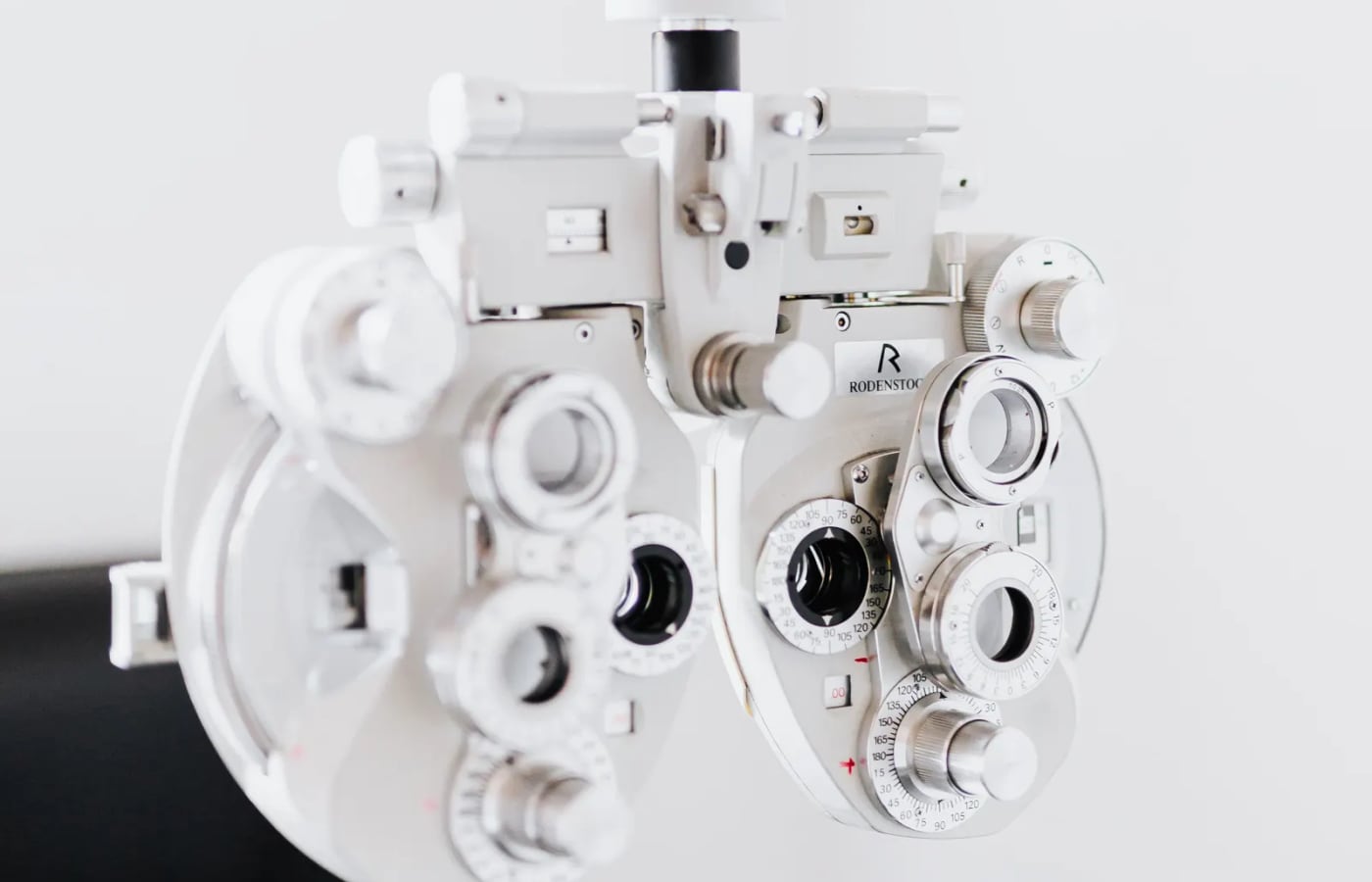
Excimer laser refractive surgery reshapes the curvature of the cornea, the clear front window of the eye, to correct short sight, long sight and astigmatism. The laser removes a very thin layer of corneal tissue following a profile calculated from your prescription and from detailed measurements of your eyes. The aim is to reduce dependence on glasses or contact lenses, not to abolish it as a matter of principle.
The same laser is used in two main ways. In surface treatment, the thin outer skin of the cornea is removed before the laser is applied and then grows back. In flap-based treatment, a thin hinged flap is created, the laser reshapes the tissue beneath it, and the flap is laid back in place. The choice depends on your corneas, your prescription and your way of life, and it shapes how quickly you recover.
Are your eyes suited to laser correction?
No laser is approved for anyone under eighteen, and the prescription must have been stable for a year. Excluded or treated as high risk: thin corneas, large pupils, pre-existing dry eye, which surgery tends to aggravate, keratoconus, glaucoma, uveitis, herpes simplex, autoimmune disease, immunodeficiency and diabetes. Contact sports are a contraindication for flap-based treatment, and some employers and armed services prohibit the surgery outright, which is worth checking before rather than after.
Several other points deserve an honest conversation:
- From the mid-forties onwards, the natural loss of near focus means that reading glasses will still be needed after a correction for distance, unless a deliberate strategy such as one eye set for near is chosen and tested first.
- Very high prescriptions may be better served by other options, such as a lens implanted inside the eye, rather than removing a large amount of corneal tissue.
- Pregnancy and breastfeeding can make the prescription fluctuate; it is wiser to wait.
- Contact lenses change the shape of the cornea. You will be asked to stop wearing them for a period before the measurements, longer for rigid lenses than for soft ones.
Do not rush the decision. A good consultation explains not only what will be done but also in which situations it should not be done.
What happens in the laser room
The eyes are numbed with anaesthetic drops; some clinics also offer a mild relaxing tablet. A small clip keeps the eyelids open, and you are asked to look at a target light while an eye tracker follows small movements. The laser itself usually works for well under a minute per eye, and the whole procedure for both eyes takes around 15 minutes. You feel pressure rather than pain, may notice a clicking sound and a smell, and vision dims briefly during the flap-based steps.
Surface treatment leaves no flap, which suits thinner corneas and people exposed to blows to the face. A bandage contact lens is placed for a few days; discomfort is greater over the first days, and vision recovers more gradually. Flap-based treatment gives faster visual recovery, usually within 24 to 48 hours, at the cost of rare flap-related complications and a tendency to more dryness in the first months. A different laser technique that removes a small disc of tissue through a tiny incision also exists; it is not excimer surgery, and its pros and cons should be discussed separately if offered.
Your three days in Istanbul
Day 1 – full eye examination. After arrival and transfer to your hotel, the examination takes a few hours: measurement of your prescription, corneal mapping and thickness, pupil size, tear film assessment and an examination of the inside of the eye, often with drops that blur near vision for several hours. You then see the surgeon with an interpreter, go through the results and the proposed technique, and sign a written consent if you decide to go ahead. Do not plan to drive that day.
Day 2 – surgery. You come without make-up or perfume, the procedure is performed, and you return to the hotel to rest with your eyes closed. Protective shields are used for sleeping.
Day 3 – check and flight home. The surgeon examines both eyes, checks your vision and the healing surface, explains the drop schedule and confirms that you are fit to fly. Flying is generally possible at this stage after flap-based treatment; cabin air is dry, so keep lubricating drops in your hand luggage. After surface treatment the bandage lens may still be in place, and its removal is either planned with an eye doctor at home or by extending your stay.
What your written quote should cover
Esthappy organises the stay and sends a written quote listing exactly what is included. For excimer laser it should cover:
- the full pre-operative examination and corneal measurements;
- the surgery for one or both eyes, and the technique proposed;
- the prescribed drops and eye shields;
- the post-operative check before your flight;
- your hotel, airport and clinic transfers, and an interpreter;
- remote follow-up and a written report of your measurements and treatment.
Ask what happens if a small residual correction remains after healing: whether a further treatment is possible and under what conditions.
Recovery, from the first evening to six months
First 24 to 48 hours. Watering, a gritty feeling, light sensitivity and hazy vision are usual. After flap-based treatment most people see well enough for screens and desk work within 24 to 48 hours, with regular breaks.
First week. Antibiotic, anti-inflammatory and lubricating drops are used on a precise schedule. Do not rub your eyes, wear the shields at night, avoid eye make-up, swimming, saunas and dusty places. After surface treatment discomfort often peaks around the second or third day and vision improves over a week or more.
Weeks 2 to 4. Driving is possible once your vision meets the legal standard and a doctor has confirmed it. Sports resume progressively; contact sports wait longer.
Months 1 to 6. Vision stabilises gradually. Dryness, halos and glare at night usually lessen over several months, more slowly after surface treatment. Lubricating drops may be needed for some time.
What the published outcome figures mean
A synthesis of 97 articles covering 67,893 eyes reported 99.5% of eyes better than 20/40, 90.9% within 0.5 dioptres of target and 98.6% within 1.0 dioptre, with loss of two or more lines in 0.61% and dissatisfaction in 1.2%. The verified figure is better than 20/40, not 20/20; where an advertisement claims 20/20, it has misread its own source.
Risks, including symptoms that go under-reported
A regulator-run quality-of-life study found over 95% of patients satisfied and under 1% with a lot of difficulty in daily activities. In the same study, among patients with no symptoms beforehand, up to 46% reported at least one new visual symptom at three months, including new halos in up to 40% and new dry-eye symptoms in up to 28%. Patients were more than twice as likely to report a symptom on a questionnaire as to mention it to their clinician, so clinic-collected satisfaction data systematically under-reports. The regulator also states that long-term safety and effectiveness are not known and that severe dry eye may be permanent.
Other risks include under- or over-correction, gradual regression of the effect, flap complications, infection, which is rare, and corneal ectasia, a rare progressive weakening of the cornea. They are reduced by thorough screening of corneal shape and thickness, treating dry eye before surgery, choosing the technique to suit your eyes, sterile conditions and following the drop schedule closely.
Questions to ask before booking
- Which technique do you recommend for my eyes, and why not the other one?
- What did my corneal mapping and thickness show, and how was ectasia risk assessed?
- Has my tear film been checked, and what is planned if my eyes are already dry?
- Who performs the surgery, and who examines me afterwards?
- What is the plan if halos or dryness persist?
- Is a further treatment possible if a residual correction remains?
After you return home
Arrange your check within the first month with an eye doctor in your own country before you leave. Keep the written report of your pre-operative prescription, corneal measurements and treatment parameters: it is needed for any later eye care, and especially if you have cataract surgery many years from now, when it helps the lens calculation. Send updates to the medical team at one week, one month and three months.
See an eye doctor the same day if you notice increasing pain, a drop in vision, marked redness, discharge or new sensitivity to light after the first days. These signs are uncommon, but they need prompt attention wherever you are.