
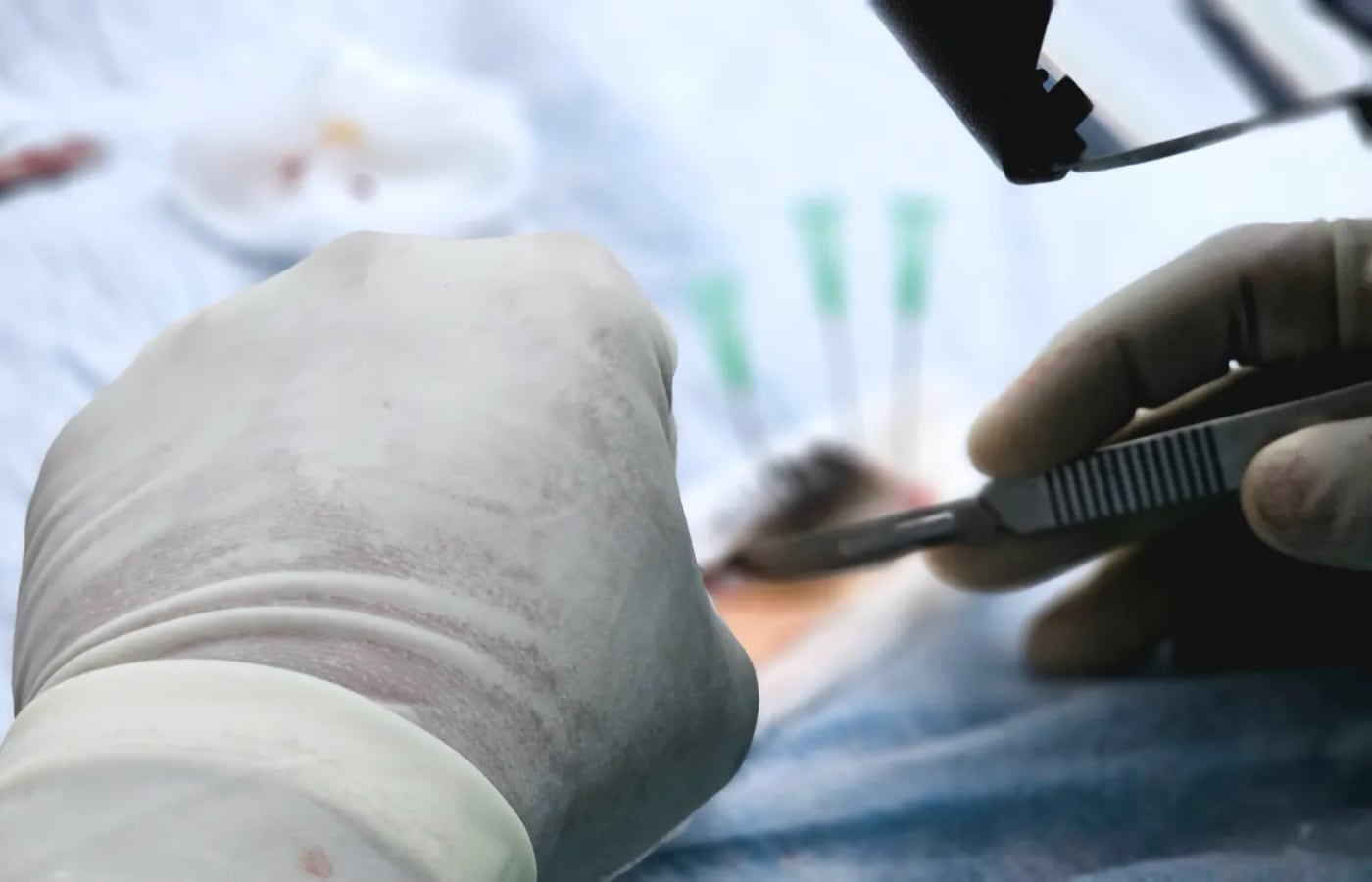
An eyebrow transplant moves follicular units from the scalp into the brow to rebuild a line thinned by repeated plucking, a scar, illness or age. The work is closer to miniature painting than to coverage: a few dozen grafts, placed one at a time, decide whether the result reads as a brow or as a row of hairs.
Designing the brow
Typical numbers are 70 to 90 grafts per brow for a woman and 150 to 200 for a full male brow. The design is built as five to seven arched rows across three zones: the head, about 10 to 15% of the length; the body, roughly 60% and the densest part; the tail, 20 to 25%. Hair direction runs vertically at the medial head and turns horizontal through body and tail. The angle sits almost flat against the skin and spacing falls between 1 and 1.5 mm. These settings, more than graft count, decide whether a brow looks natural.
How growth arrives
Growth is staged: 50 to 60% of the result by three to four months, a further 20 to 25% between five and six months, and the last 10 to 15% by seven to eight months, so the brow is complete at around eight months. Graft loss of 5 to 10% is expected. Session data are worth knowing: 14% of patients have one session, 77% have two and 9% have three, so a refinement is the norm rather than a failure.
Living with it
Transplanted scalp hair keeps scalp growth behaviour and continues to lengthen. It has to be trimmed every two to three weeks, indefinitely. This is the commitment patients most often underestimate.