
A cause-first look at hormonal changes, inherited thinning, medical assessment and the limits of hair transplantation.
Hormones can change your hair’s growth cycle or contribute to inherited thinning, but what may help depends on the cause rather than a single hormone level.
Shedding and gradual thinning tell different stories
What changes in the hair growth cycle
More hairs during washing, a widening part and a receding hairline offer different clues. Tell your clinician whether the change was sudden or gradual and whether it affects your whole scalp or particular areas. These details guide examination but cannot establish the cause alone.
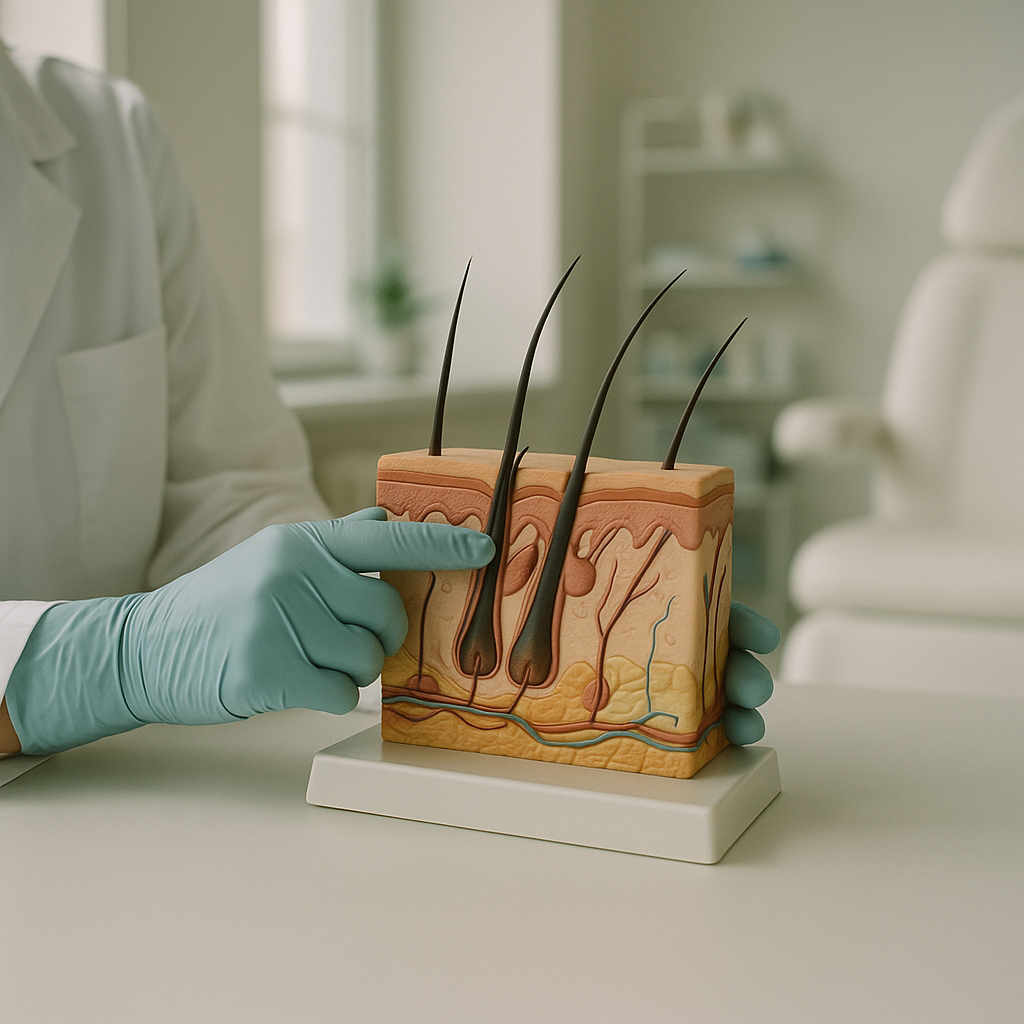
“Hormonal hair loss” describes several possible processes, not a single diagnosis. Each follicle moves independently through growth (anagen), transition (catagen) and rest (telogen), followed by shedding. Increased shedding occurs when more hairs than usual reach the shedding stage together. Gradual thinning can instead reflect follicles producing finer, shorter hairs over successive cycles.
Both processes can overlap. An assessment through cosmetic dermatology services can help distinguish shedding from progressive thinning by reviewing the distribution of loss and differences in hair thickness.
DHT, inherited sensitivity and thinning patterns
According to MedlinePlus Genetics, androgens, including dihydrotestosterone (DHT), contribute to androgenetic alopecia alongside genetic factors. DHT is made from testosterone. In susceptible follicles, inherited sensitivity to androgen signals can shorten the growing phase, producing progressively finer hair.
You may notice temple recession, crown thinning or a widening central part; none is exclusive to a particular sex. The speed and extent of change depend on inherited susceptibility, age and overlapping causes of shedding. A relative’s hairline cannot reliably forecast your own.
Testosterone levels alone do not determine whether thinning develops, so lowering testosterone is not a universal treatment. There is also no established evidence that masturbation causes androgenetic alopecia. This concern alone does not justify hormone testing; the timing, distribution and accompanying symptoms of hair changes are more useful clues.
Hormonal changes across reproductive stages and daily life
Pregnancy, menopause and contraceptive changes
During pregnancy, hormonal shifts can keep more hairs growing; after birth, more may enter rest and subsequently shed. Shedding can become noticeable around 2–4 months after childbirth, a medication change or significant illness. The American Academy of Dermatology’s information on excessive hair shedding describes this delayed response to a trigger.
Around menopause, declining oestrogen acts alongside ageing and inherited susceptibility. A change in scalp hair does not establish progesterone deficiency or justify progesterone treatment, despite this hormone’s role in reproductive physiology. Neither pregnancy nor menopause explains every new change in density.
Starting, stopping or changing hormonal contraception may coincide with shedding or altered patterned thinning. Formulations differ in their androgen-related effects, but choices also depend on reproductive priorities and medical history, including clotting risks. Bring the product name and dates of changes to your consultation rather than stopping contraception because of shedding alone.
Thyroid disease, PCOS and stress-related shedding
An underactive or overactive thyroid can accompany diffuse thinning. Your symptoms and medical history determine whether thyroid assessment is appropriate; hair appearance cannot identify either condition.
Irregular periods, acne or increased facial hair alongside thinning may prompt assessment for polycystic ovary syndrome (PCOS). These features do not establish the diagnosis. Insulin resistance can be relevant to that assessment, but hair loss alone does not demonstrate an insulin problem.
Significant physical or emotional stress can precede telogen effluvium: more follicles enter rest, followed by increased shedding. Ordinary stress does not prove a cortisol disorder. Illness, reduced food intake and disrupted sleep may contribute during the same period.
If you use gender-affirming hormones, discuss hair changes with the prescribing clinician. Testosterone-based and oestrogen-based regimens can affect scalp hair differently, depending on inherited sensitivity and existing thinning. Do not independently adjust prescribed hormones for a hair concern.
An examination matters when several causes overlap
Which clinician to see and what the scalp can reveal
A widening part may become more noticeable after illness or reduced food intake. An assessment needs to consider iron deficiency, inadequate nutrition and medication effects rather than assuming a hormonal cause.
Start with a primary-care physician to review your health and medicines. A dermatologist with experience in hair disorders can examine your scalp; an endocrinologist may contribute if your history or test results suggest an endocrine concern. Before the visit, record:
- Timing and distribution: sudden or gradual onset; diffuse, patterned or patchy loss.
- Scalp and family history: itching, pain, bumps, redness and relatives with thinning.
- Recent changes: illness, weight change, restrictive eating, medicines and tight hairstyles.
- Reproductive history, where relevant: childbirth, menstrual changes and contraceptive changes.
Scalp inspection checks for inflammation, traction and the distribution of loss. Magnified examination, called trichoscopy, shows differences in hair thickness and the openings where hairs emerge. Patchy loss, pain, marked redness or apparent scarring need medical assessment rather than an assumed hormonal explanation. For follicle-centred bumps, how folliculitis develops and which symptoms it causes explains a different possible process.
Photographs or an online consultation cannot replace an appropriate examination. The final decision about diagnosis, treatment suitability and whether hair transplantation has a role belongs to the examining physician.
Targeted tests rather than a universal hormone panel
Your history and examination determine which investigations could change management:
- Restricted intake, heavy menstrual bleeding or fatigue: a blood count and ferritin can assess anaemia and iron stores.
- Thyroid symptoms or history: thyroid-stimulating hormone (TSH), with additional thyroid tests when indicated, may help.
- Irregular periods with acne or increased facial hair: targeted androgen tests may be considered.
- Tight hairstyles, medication changes or inflammation: the findings may direct assessment away from hormones.
The American Academy of Dermatology’s information on hair-loss diagnosis explains that blood tests or a scalp biopsy may be considered when examination suggests disease, deficiency, infection or a hormonal problem. A biopsy involves taking a small scalp sample for laboratory examination; it is not routine for every case. There is no universal test panel, and commercial saliva panels do not establish the cause of hair loss.
Match treatment to the cause, then allow time
Medical options and their different purposes
Correcting confirmed iron deficiency or treating a diagnosed thyroid disorder addresses a trigger, but does not replace treatment for coexisting androgenetic alopecia. Supplements are not a general hair-growth treatment without an identified deficiency.
The American Academy of Dermatology’s information on hair-loss treatment identifies minoxidil as an option for certain forms of thinning and states that treatment depends on the cause. Medicines have different purposes:
- Topical minoxidil: applied to the scalp to support growth in selected forms of thinning; it does not correct thyroid or nutritional problems.
- Oral finasteride: reduces DHT formation and may be considered for appropriately selected adults with patterned thinning.
- Clinician-prescribed spironolactone: reduces androgen effects and may be considered in selected circumstances, particularly for female-pattern hair loss.
Licensing and prescribing outside an approved indication, known as off-label use, differ between countries, including Türkiye and your home country. Ask which diagnosis a medicine addresses and who would supervise follow-up after you return home.
Regrowth expectations and useful progress checks
After a temporary trigger resolves, shedding may settle over approximately 3–6 monthsvisible density can take longer to assess. Progressive thinning often needs ongoing management. Outcomes differ between temporary shedding and longstanding follicle thinning, and also depend on coexisting conditions and whether follicles remain capable of growth.
Allow approximately 6–12 months to assess visible density changes with medical treatment or recovery from postpartum or contraceptive-related shedding. This is a review window, not a promised recovery date. Persistent loss after stopping contraception may indicate another contributor rather than a prolonged response to the contraceptive change alone.
Take photographs with the same parting, lighting, camera distance and hair condition. Comparing these over time is more useful than reacting to a single wash-day hair count. If you review examples of treatment resultsremember that selected examples cannot predict your response, particularly when they involve a different treatment.
For postoperative changes, the recovery stages after a hair transplant provides a separate surgical timeline, not a model for hormonal shedding.
| What you notice | Possible explanation | Useful assessment focus | What the appearance cannot establish |
|---|---|---|---|
| Gradual widening of the part or temple and crown thinning | Inherited pattern hair loss | Distribution, family history and signs of finer hairs on scalp examination | Whether blood androgen levels are elevated |
| Increased shedding across the scalp after a life or health change | Telogen effluvium | Trigger history, medication changes, nutrition and scalp examination | Whether a hormonal change is the only cause |
| Diffuse thinning with symptoms that could suggest thyroid dysfunction | A possible thyroid contribution | Clinical history and targeted thyroid testing | Whether thyroid activity is low or high |
| Longstanding patterned thinning with a recent increase in shedding | Overlapping pattern hair loss and temporary shedding | Assessment of both the established pattern and the recent trigger | Which component will respond to a particular treatment |
Who should defer treatment, and what are the risks?
Situations in which medicines or transplantation may not fit
Tell your prescribing clinician if you are planning conception, are pregnant or are breastfeeding before starting hair-loss medication. These circumstances affect medication selection and whether an existing prescription should be changed or stopped. Finasteride and spironolactone are avoided in pregnancy. Minoxidil is generally avoided during pregnancy and breastfeeding unless a treating clinician advises otherwise after reviewing your circumstances. Discuss alternatives rather than switching products yourself.
Active unexplained shedding, an untreated contributing disorder or active inflammatory scalp disease can make transplantation inappropriate at that stage. The cause needs assessment before surgical planning proceeds. Insufficient stable donor hair can also rule out surgery: diffuse thinning across the potential donor area may leave too few reliable follicles to relocate. An explanation of how graft estimates depend on the donor area helps clarify why a requested coverage area cannot determine the plan alone.
Products marketed as “hormone-balancing” supplements are not substitutes for identifying the cause. Unsupported claims about restoring hormonal balance differ from prescribed treatment for a diagnosed condition. Supplements may also interact with medicines; bring their ingredient lists to your consultation.
Possible side effects and procedural complications
Topical minoxidil can irritate the scalp, cause unwanted facial hair and produce an early increase in shedding. Finasteride is associated with sexual side effects and mood changes. Spironolactone can cause dizziness, menstrual changes and raised potassium in susceptible people, including those with kidney problems or relevant medicine interactions.
Monitoring depends on the medicine and your medical history. It may include reviewing symptoms, checking blood pressure or measuring kidney function and potassium. Ask which changes require contact with the prescriber and whether tests are needed before treatment or after dose adjustments. A monitoring plan should be specific to the prescription, not a generic package.
Transplant-related complications include bleeding, infection, swelling, altered sensation, scarring, temporary shedding and uneven growth. Outcomes differ between people according to donor quality, the extent of thinning and ongoing hair loss. Before consenting, ask how complications would be assessed and managed, including whom you would contact outside scheduled reviews.
Before you travel to Türkiye, define the role of a transplant
What surgery changes and what it cannot change
If you are researching from a French-speaking European country, separate the purpose of surgery from treatment of the underlying cause. Transplantation relocates follicles. It does not correct a thyroid disorder, resolve a hormonal trigger or stop thinning in surrounding non-transplanted hair. Medical treatment may therefore remain part of your longer-term plan, whether or not you choose surgery.
FUE describes the extraction of individual follicular units from the donor area. Sapphire blades are instruments used to create recipient sites. DHI-style implantation tools place follicles into the receiving area. These describe different parts of the procedure, not three interchangeable treatments for a hormonal disorder; what FUE, sapphire blades and DHI describe explains that distinction in more detail. Ask which steps are proposed and why.
When reviewing hair transplant photographs you can examine closely, look for comparable lighting, angles and follow-up timing. Individual examples cannot predict your coverage, hairline appearance or later changes.
A practical plan for assessment and follow-up abroad
Before arranging travel to Türkiye, ask how hair transplantation is planned, including hair assessment, technique selection and hairline design. Clarify what remains provisional until an in-person examination. Request a written plan for follow-up through the first year; scheduled reviews provide opportunities to assess progress, but do not ensure an outcome.
- Identify who conducts the examination, who performs each surgical step and who explains the findings.
- Request an explanation of surgical and nonsurgical options, including what each would address.
- Ask whether French-language explanations or an interpreter are available, and request written consent information you can understand before deciding.
- Establish who prescribes ongoing medication and how prescriptions will continue after you return home.
- Agree how remote reviews and local examinations will be coordinated, who receives updates and whom you contact with concerns.
Photographs and remote discussions can support planning, but they do not replace examination. Keep the surgical plan open to revision after assessment. The final decision about medical suitability belongs to the examining physician; whether to proceed remains your choice, made with time to consider the options.
Frequently asked questions
-
Yes. Your follicles can be sensitive to androgens even when the amount measured in your blood is within the laboratory’s reference range. Normal results therefore do not rule out inherited pattern hair loss, but they also do not prove that hormones explain your shedding.
-
HRT is not usually prescribed solely to treat scalp hair thinning, and you should not expect a predictable hair response. If you are considering it for menopausal symptoms, discuss the potential benefits and risks with the clinician managing your menopause care. Your hair concerns may need a separate assessment and treatment plan.
-
Tell the clinician and laboratory if you take biotin, including supplements sold for hair and nails, because it can interfere with some thyroid test results. Ask whether you need to pause it and for how long; the answer depends on the dose and the laboratory method. Do not stop a prescribed supplement without checking with its prescriber.
-
Ask the receiving medical team which languages they accept before paying for a translation. Bring your original reports, laboratory reference ranges and medication names with doses, even if you also provide translated copies. A summary should support access to the original information rather than replace it.
Sources
- MedlinePlus Genetics
- American Academy of Dermatology, Do you have hair loss or hair shedding?
- American Academy of Dermatology, Hair loss: Diagnosis and treatment