
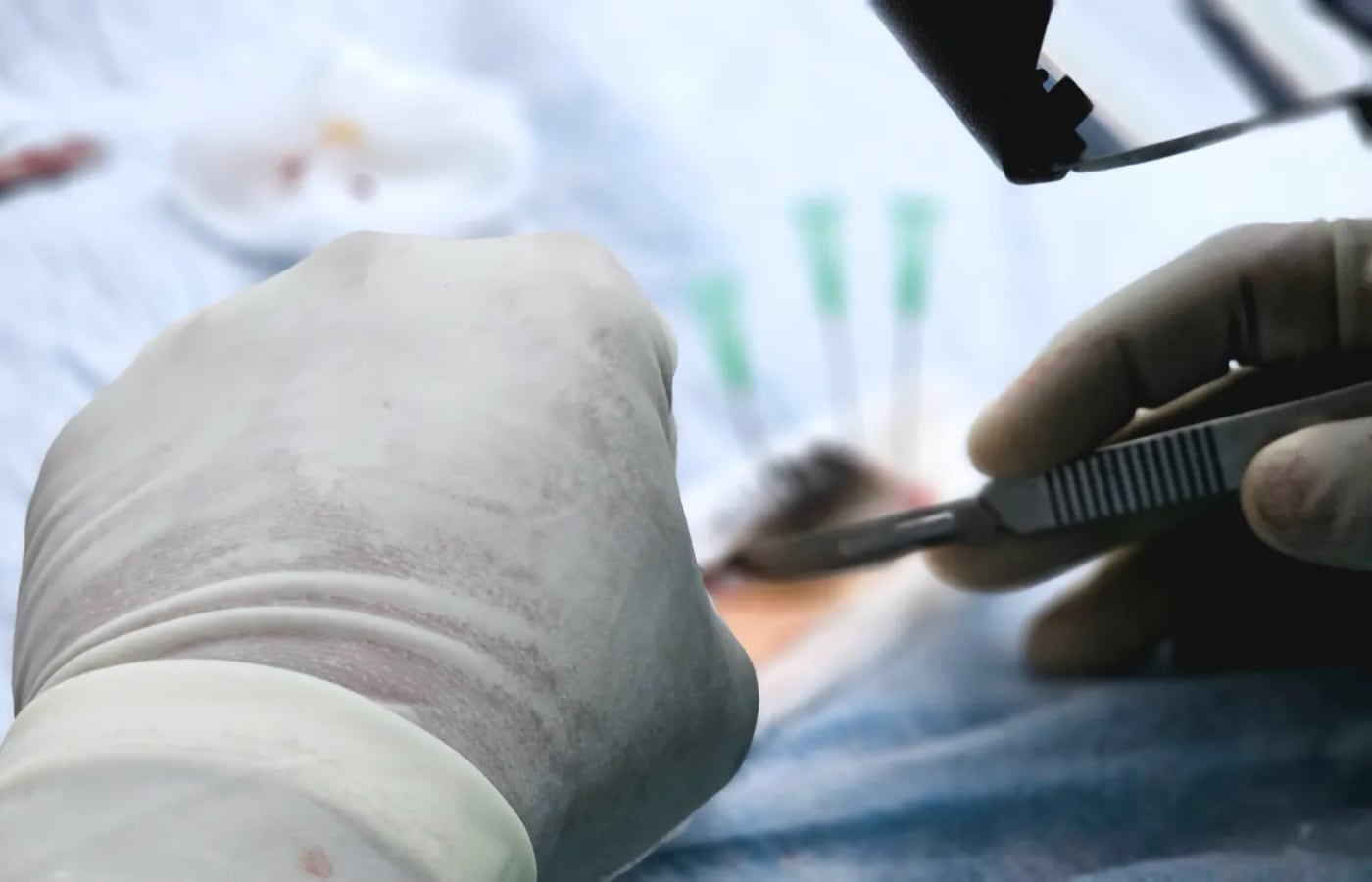
Sapphire FUE is follicular unit extraction in which the surgeon opens the recipient sites with a fine blade cut from synthetic sapphire instead of surgical steel. The name describes an instrument, not a different operation. Follicular units are still removed one at a time from the back and sides of your head with a punch of 0.8 to 1.0 mm, the recipient micro-channels are still opened through the skin, and the grafts are still placed by hand or with forceps.
This page explains what the sapphire blade really changes, what decides how many grafts survive, how three days in Istanbul are organised, and what recovery looks like until the final result, which takes a year or more. It also sets out the questions that tell you more about a team than the name of its blade.
Who Sapphire FUE suits, and who should wait
FUE with sapphire-opened sites suits men and some women with stable, patterned hair loss and a donor area dense enough to give the grafts needed without visible thinning. Typical candidates have a receding hairline, thinning temples, a thinning crown, or a combination, and want a natural result rather than maximum density at any cost.
Some situations call for waiting or another route:
- Early or fast-moving loss, especially in your early twenties, where the final pattern is not yet clear and a hairline built too low could look out of place later.
- A weak donor area, which limits the number of grafts that can be removed safely, whatever instrument is used.
- Diffuse thinning without a stable pattern, active alopecia areata, scarring alopecias that are not quiet, or shedding linked to anaemia, thyroid disease or recent illness: these need a medical work-up first.
- Uncontrolled diabetes, bleeding disorders or blood thinners that cannot be adjusted with your own doctor's agreement.
Medical treatment to protect the hair you still have is often discussed alongside surgery, because a transplant does not stop the loss of native hair around it.
How the operation runs
The session takes roughly 6 to 8 hours under local anaesthesia, with breaks. You are awake, can talk and listen to music, and the anaesthetic is topped up as needed. The order is the same as any FUE:
- Design. The surgeon draws the hairline and the zones to be covered with you, in front of a mirror, and agrees the graft target with the donor reserve in mind.
- Harvesting. The donor area is shaved short and units are extracted one by one with a 0.8 to 1.0 mm punch. Grafts are counted, sorted by number of hairs and kept cool and moist.
- Recipient sites. Here the sapphire blade is used. The surgeon opens micro-channels through the skin (sometimes marketed as percutaneous), setting their angle, direction and density zone by zone.
- Placement. Grafts are placed into the channels, single-hair units at the front for a soft line, larger units behind for density.
What the blade actually changes
The peer-reviewed literature compares blade geometry and cutting mechanism, not the material a blade is made from. No trial has shown that sapphire improves graft survival. The profession's international body does not recognise sapphire FUE, ice FUE, gold FUE or third-generation FUE as distinct procedures; these are trade names attached to an ordinary step. A fine, regular blade is a reasonable tool that many surgeons like for its sharpness and consistency. It is simply not a clinical argument on its own, and it should not carry a price premium by itself.
What really drives the outcome
Three things matter far more. First, time out of the body: survival falls as the hours pass, broadly 95% at two hours against 79% at twenty-four, a trend rather than a precise curve. Second, storage between 4 and 10 degrees Celsius, given that as little as three minutes of dry exposure can kill grafts. Third, packing density: published series show survival dropping as density approaches 30 units per square centimetre, a finding that is contested and heavily operator-dependent. Incision angle also matters mechanically, since a 5 mm slit penetrates 5 mm at 90 degrees but only 1.3 mm at 15, against an average scalp thickness of 4.3 mm.
Three days in Istanbul
A standard Sapphire FUE stay is 3 days:
- Day 1 – arrival and consultation. Airport transfer to your hotel, then the clinic: scalp examination, review of your medical history and medication, blood tests, photographs, and the hairline design discussion with the surgeon. You can still change your mind at this point.
- Day 2 – operation. Transfer in the morning, a full day in the clinic, return to the hotel in the evening with a headband or light dressing, medication and written instructions.
- Day 3 – check and first wash. The team checks the donor and recipient areas, carries out or shows you the first gentle wash, and confirms that you are fit to fly before your transfer to the airport.
What your written quote should spell out
Esthappy organises the consultation, surgeon and clinic fees, hotel, airport and clinic transfers and an interpreter. Post-operative medication, the shampoo and lotion for the first weeks and a neck pillow are often part of the package. Check that the written quote names exactly what is included, the graft target or range agreed after examination, who performs each step, and what happens if a follow-up visit is needed. If something is not written down, ask before you book.
Recovery, from the first night to the final result
- Days 1 to 3. Tightness and soreness in the donor area are common and usually managed with simple painkillers. Sleep with your head raised. Swelling of the forehead may appear on day 2 or 3 and settles within a few days.
- Week 1. Small crusts form around each graft. You wash daily as shown, without rubbing. Most people with desk jobs go back to work after 3 to 5 days, often with a loose cap.
- Week 2. Crusts fall away by around day 10. Redness fades over the following weeks, more slowly on fair skin. Light exercise usually resumes after about a week, sport, sauna and swimming after about a month.
- Weeks 2 to 8. Most transplanted hairs shed. This is expected: the follicles stay in place and rest.
- Months 3 to 4. New hairs start to grow, fine at first. The area can look thinner than before surgery around month 3.
- Months 6 to 9. Most people see the result take shape.
- Months 10 to 18. The final result settles; the crown is often the slowest area.
Risks and how they are reduced
Hair transplantation is minor surgery but it is surgery. Possible problems include swelling, bleeding, infection, folliculitis (small spots around growing hairs), numbness of the scalp for weeks or months, temporary shedding of native hair around the grafts, cysts, visible thinning of an over-harvested donor area and lower-than-expected growth. Temporary shedding of surrounding hair is common, usually mild, and recovers in 3 to 6 months.
Risk is reduced by honest graft planning against the donor reserve, short out-of-body times, cold storage, careful handling by an experienced team, a transection rate held under 10%, sterile technique and clear aftercare. Diagnosis, surgical planning, harvesting, hairline design and the opening of recipient sites should be carried out by a licensed physician, not delegated to technicians.
Questions to ask before booking
- Who makes the recipient incisions, and who designs the hairline?
- What transection rate does the team work to?
- How long will grafts sit outside the body, and at what temperature are they kept?
- How many grafts does my donor area allow over my lifetime, not only today?
- What density is planned in each zone, and why?
- Will the doctor who examines me be present during the operation?
- What medical treatment do you recommend to protect my existing hair?
After you return home
You leave with written aftercare instructions, a summary of the operation including the number of grafts, and the list of medication. The team follows you remotely: you send photos at agreed points, typically at one week, one month, three, six and twelve months, and your questions are answered through your coordinator. See a local doctor promptly if you notice spreading redness, pus, increasing pain, fever or a swelling that grows rather than settles. Keep your documents to hand for that visit. Ongoing medical treatment for hair loss is usually followed with a dermatologist near you.