
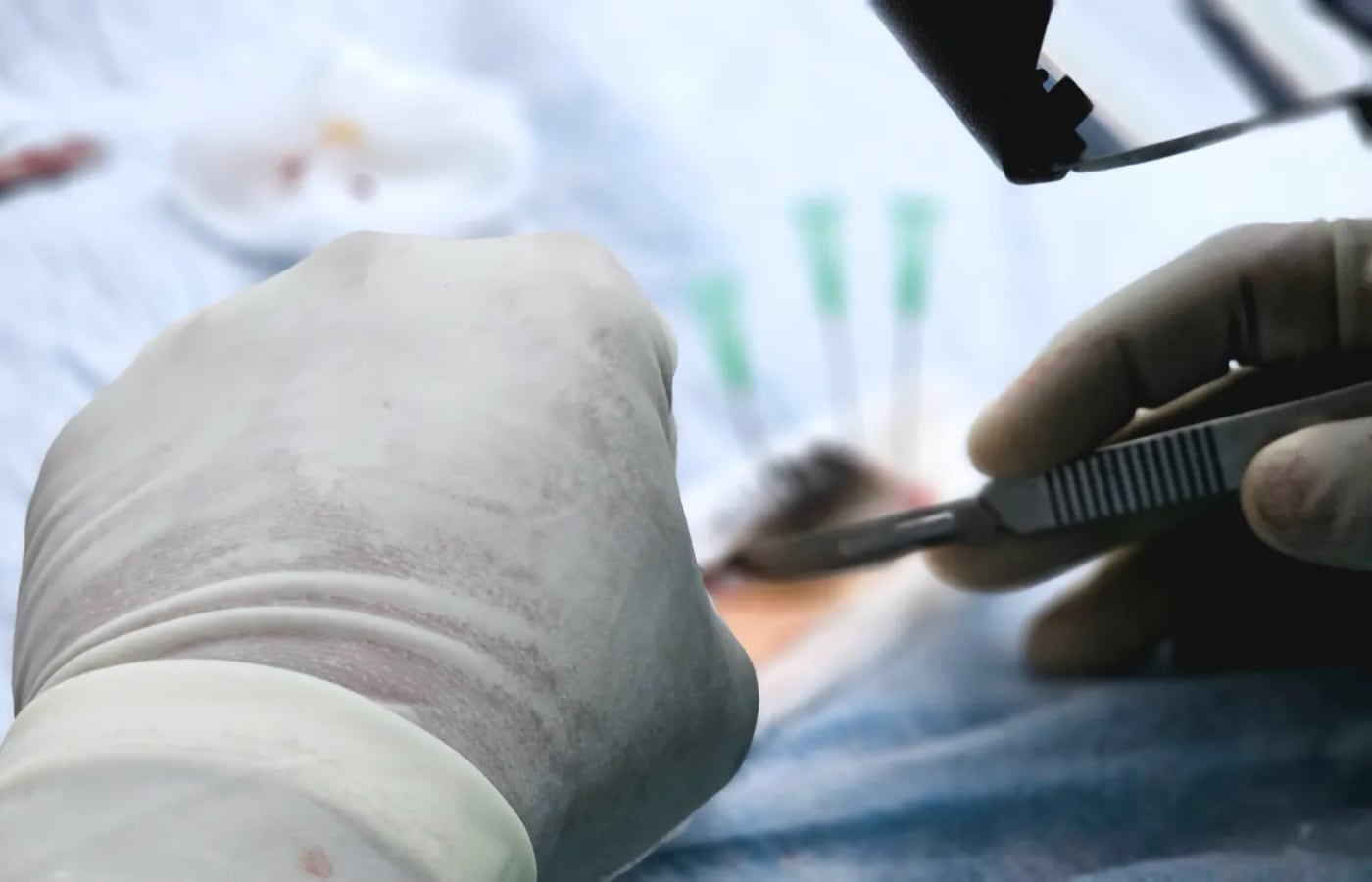
A beard transplant thickens sparse facial hair, covers a scar, or rebuilds a moustache, goatee or sideburns. Grafts usually come from the occipital donor area and are placed overwhelmingly as one- and two-hair units, since larger units on the face read as tufts rather than stubble.
Working out the numbers
The usual planning figures are 300 to 400 grafts per side for a moustache, so 600 to 800 in total; 600 to 700 for a goatee; around 200 per side for sideburns; 2,000 to 2,500 for a full beard on a bare area; and 300 to 400 to cover a small scar. As anatomical reference points, native density runs 45 to 50 units per square centimetre on the cheek, 75 to 80 on the chin, 85 to 90 on the lateral moustache and 150 to 160 centrally. Those are comparisons, not targets to reach in one sitting.
The angle problem
Facial incisions are made at 10 to 20 degrees to the skin, far flatter than on the scalp. An angle set too upright produces hair that stands away from the face and is obvious at a glance. This, rather than graft count, is the technical difficulty of the operation.
Recovery and what can go wrong
Redness and swelling last two to three days. Transplanted hairs shed and then regrow from three to four months, with the overall result judged between ten and fourteen months. Described complications include cobblestoning, a pitted or raised texture seen especially on the chin and under the lower lip, grafts placed in the wrong direction, folliculitis, and post-inflammatory hyperpigmentation, which is more likely on darker skin.