
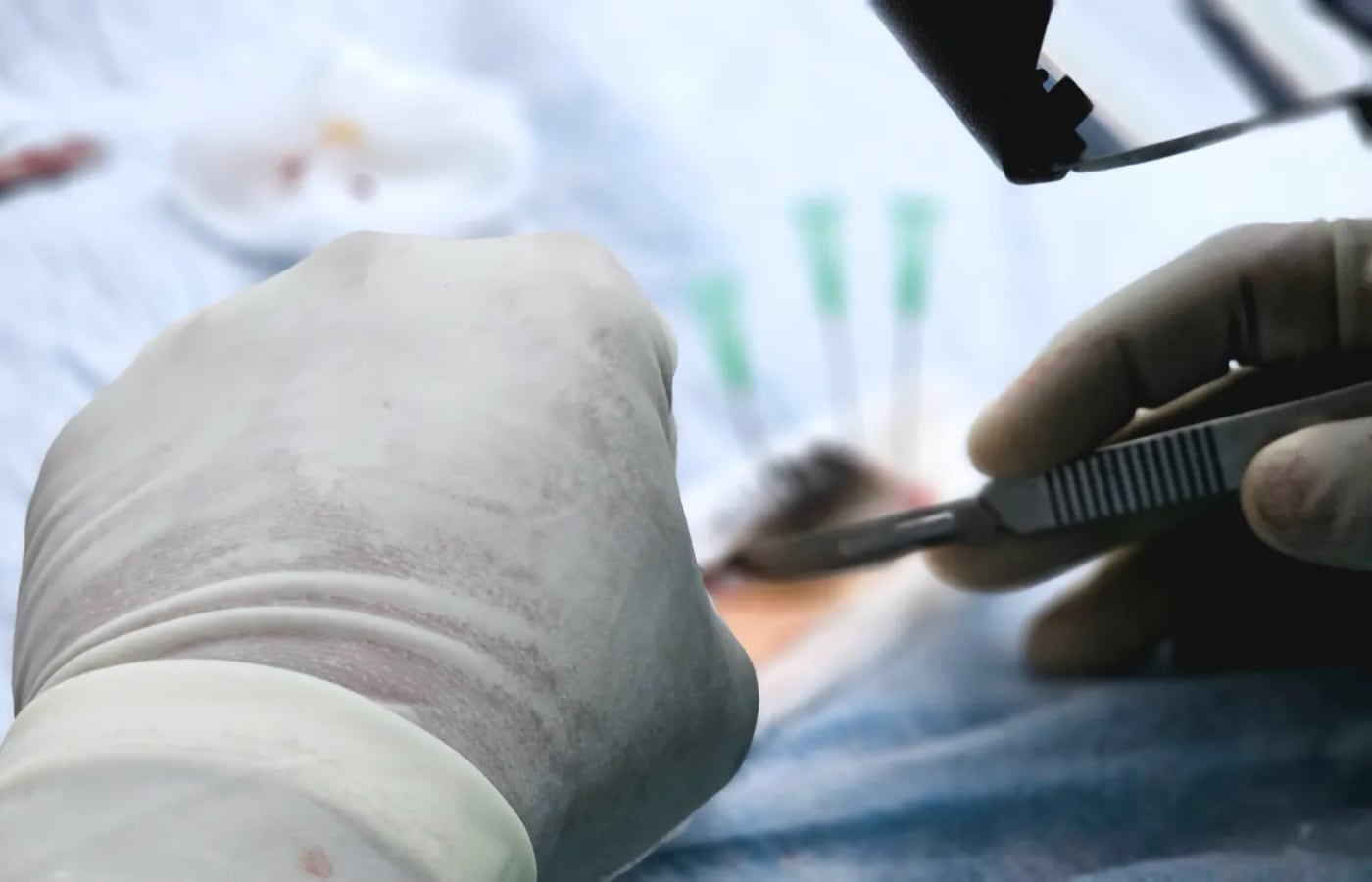
A sapphire technique is an instrument, not an operation. The surgeon opens the recipient sites with a blade cut from synthetic corundum rather than from surgical steel. Everything else is a standard follicular unit extraction: units are harvested one at a time with a punch of 0.8 to 1.0 mm, recipient incisions are made, and the grafts are placed.
What the blade actually changes
The peer-reviewed literature compares blade geometry and cutting mechanism, not the material a blade is made from. No trial has shown that sapphire improves graft survival. The profession's international body does not recognise sapphire FUE, ice FUE, gold FUE or third-generation FUE as distinct procedures; these are trade names attached to an ordinary step. A fine, regular blade is a reasonable tool. It is simply not a clinical argument on its own, and it should not carry a price premium by itself.
What actually drives the outcome
Three things matter far more. First, time out of the body: survival falls as the hours pass, broadly 95% at two hours against 79% at twenty-four, a trend rather than a precise curve. Second, storage between 4 and 10 degrees Celsius, given that as little as three minutes of dry exposure can kill grafts. Third, packing density: published series show survival dropping as density approaches 30 units per square centimetre, a finding that is contested and heavily operator-dependent. Incision angle also matters mechanically, since a 5 mm slit penetrates 5 mm at 90 degrees but only 1.3 mm at 15, against an average scalp thickness of 4.3 mm.
Questions worth asking
Ask what transection rate the team works to, under 10% being the professional reference; ask who makes the incisions; ask how long grafts will sit outside the body. Those answers tell you more than the blade.